| |

Political Party Platform for General Election
| The Institute of Public Policy Studies jointly organized a public affairs conversation on “Political Party Platform for General Election, December 23, 2007” with the Institute of Public Affairs and Pitak Rak Pan Din Foundation by inviting political parties to present their fundamental public policies on November 22, 2007 at Petch Pailin Room,The Emerald Hotel in Bangkok between 14.30 to 16.30 hrs. | 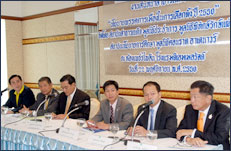
|
Seven political parties; Democrat, Pue Pandin, Ruemjai Thai Chartpatana, Palang Prachachon, Chart Thai, Pracharaj and Matchima Tipatai sent their representatives to address the forum particularly on social and economic values. The program was moderated by Prof. Dr. Somsakdi Xuto who kindly allowed each speaker to make a remark within 10 minutes equally.
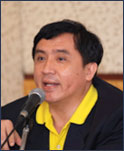
Dr. Mana Mahasuwirachai
Pracharaj Party | Dr. Mana Mahasuwirachai from Pracharaj Party said every party, in the past, had similar policy- managed liberalism- and he believes the next government will continue since policy is only broad framework or guideline for administrators to adapt with many other complex conditions. Policy is easy to speak but difficult to implement therefore the administrators are much more important than policies. Pracharaj mainly focuses on the stimulation of projects to strengthen Thailand competitativeness in the global economy, for example; on logistics. He lastly commented that Thailand has bad experiences of the corrupted projects because we have fool or corrupted administrators. Since nobody accept he corrupted so the people should choose the smart and brave candidates to run the country. |
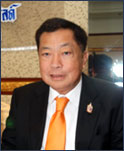
Dr. Jirayu Wasurat
Pue Pandin Party | Dr. Jirayu Wasurat from Pue Pandin Party stressed his party’s main policy is reconciliation- stop national conflicts and unite in building the country. Economy is the first priority and his party promised to boost Gross Domestic Product and make national growth rate at 5 to 7 per cent annually by 1] Strengthen investors confidentiality, 2] Public investment in mega projects, 3] Revision of regulations to stimulate investment, 4] Application of deficit budgetary system at 3 per cent of national GDP, 5] Issue of bonds for all pilot projects, 6] Comprehensive water management system, 7] Parallel development of logistics, city planning and infrastructure, 8] Development of dual track railing system with possibility of private investment but not privatization of the State Railway of Thailand , 9] Deregulate on monetary system- untie with US dollar, and 10] Encourage investment as much as possible. |
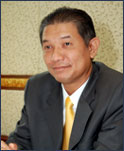
Dit-achapol Sutsukon
Matchima Tipatai party | Dit-achapol Sutsukon from Matchima Tipatai said his party also opted for moderate policy and sufficiency economy. His party focuses on creation of employment by improving the current projects and creating new ones, for example; encourage every sub-district to produce their own electricity of minimum 1 mega watt, upgrade village funds to become juristic persons, establishment of agricultural fund for farmers and common silos, stimulate manufacturing of food products from rice, establishment of agro-energy and promote E20 fuel, increase minimum wages to suit cost of living, state-run mass transit system of Bt. 15 flat rate fare in all routes, setting up of community police , etc. |
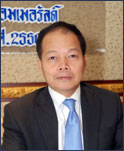
Noppadol Pattama
Palang Prachachon party | Noppadol Pattama from Palang Prachachon said his party will propose a national agenda to solve violence in the 3 southern provinces with 3 measures; 1] reconciliation, 2] democracy [ amend the current constitution on various issues; senators and polling system] and 3] economy [ implementation of mega projects; water resource development, state officers housing, rail transport etc.]. Provision of housing for newly graduates, housing along mass transit lines and state officers’ housing on the Crown Property land bank. For short term economic stimulation, village fund project will be upgraded to community bank, development of SML, SME, OTOP, public bank and rejuvenate of 1 million cow project, acceleration of the issue of land title deed and occupying rights, establishment of agricultural commodities market, encourage ethanol consumption, labor exportation- fly first pay later, free medical treatment, free education up to 12 years – free books-free uniforms, improve education standard, renewal of TCDC, TK Park, establishment of E-libraries and internet access to every person. |
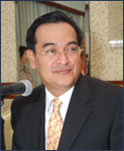
Nikorn Chamnong
Chart Thai Party | Nikorn Chamnong from Chart Thai Party said his party is recognized of being practically than verbally proved by track records. Chart Thai’s policy is to be able to implement, possible and fair to all. The party will focus on 3 levels of development as follows;
Human development: education, health, hospitals, income- debt relief for farmers and the poor, social security for the aged and disable.
Community development: asphalted road nationwide, mass transit system of rail and road.
National development: reconciliation, sufficiency renewable energy, establishment of water resource management ministry.
|
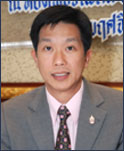
Dr. Kasemsan Veerakul
Ruamjai Thai Chartpatana, | Dr. Kasemsan Veerakul from Ruamjai Thai Chartpatana, a brand new politician of only 22 days said economic problems today is similar to those in previous 20 year ago therefore the only solution is management and more important than management are politics and social norms. Economic problems could not be solved withoutunless political conflict is solved and Thailand must strenghten her competitiveness in the world economy. As all political party’s policy is almost alike therefore whosever runs government has to maintain the guideline. Changes of national policies is more harm than good so there should be a set of national policy, under supervision of NESDB, to be adopted by any political party that runs government. Focuses should be on how to maintain economic growth at 4 per cent annually. Short term incentives are to reduce personal income tax, SME tax and pension tax. Long term incentives are investment in mega projects. Public should be fully informed on political situations. Implementation of reconciliation policy and stop all conflicts instantly after the December 23 election. |
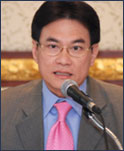
Julin Laksanawisit
Democrat Party | Julin Laksanawisit spoke about Democrat Party policies, being formulated from public needs and opinions, giving first priority to the people. Politicians must be clean , transparent and non-corrupt. He confirmed on Democrat’s policies on decentralization of power from central to local government, allow public to participate through several mechanisms such as legalization, public hearing and referendum, legal advisors to the commoners and last but not least, allowing the general public to submit a law to impeach political administrators.
35 per cent of national revenue will be allocated to local authorities and all locally business tax will be given to the local. Local referendum for self-governing authority, 15-year free and qualified schooling from kindergarten to pre-university , increase of free public health expenditure to Bt. 1,200 per head per year and Bt. 500 monthly pension allowances to all senior citizens.
Boosting of rural economy by doubling irrigation area, establishment of Bt. 1 million sufficiency economy fund in every Tambon within 90 days, securitization of agricultural products, reduction of contribution into fuel fund and 15 units free electricity to all households.
Boosting urban economy by developing logistics system, 4-lane highway nationwide, dual track railway, building ports connect Gulf of Thailand and Andaman Sea, airports improvement; lessen personal income tax to 25 per cent within 4 years.
Establishment of an office to solve southern problems by adopting economic development strategy and Islamic way of life.
|
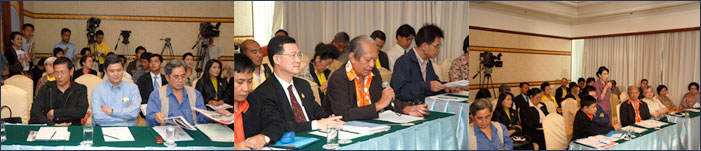
After all representatives presented their parties’ policy the press was allowed to comment and ask questions. It should be noted that most comments were on the free schooling in which everybody seemed to question on its possibility. Both Palang Prachachon and Democrat disclosed their estimated annual expenditure of approximately Bt. 30 billion and the source of money is from current fiscal budget. However, the audiences were enthusiasm to know how and where the money will comes from since every party seems to propose populist policies. The best answer might came from Palang Prachachon since the reply was from tourism industry and promoting Thailand as medical hub while Ruamjai Thai Chartpatana has different idea; deficit budgeting system and reduce tax rate to collect more tax.
The conversation ended when Dr. Somsakdi made final remark that every party has presented good policies and his comment is whether the policies came from real civic needs? Making policies without asking the public can be a mistake since Thai society has far developed during the past years. To his personal opinion, Thai society mostly comprises of middle-class-middle-income population, escalating themselves to become better-off, so populist policies might not suit all citizens since this group of people wants quality not quantity services. Thai people has proved themselves one of the best adaptive to all situations. Whenever crisis happened the ordinary Thai people modified and survive so the most important thing now is political stability. He asked the political parties not to create chaotic but stabilize political environment. “ If this request is achieved, having good public policy or not will make no difference” was Dr. Somsakdi’s final remark
From : http://www.fpps.or.th
|
|